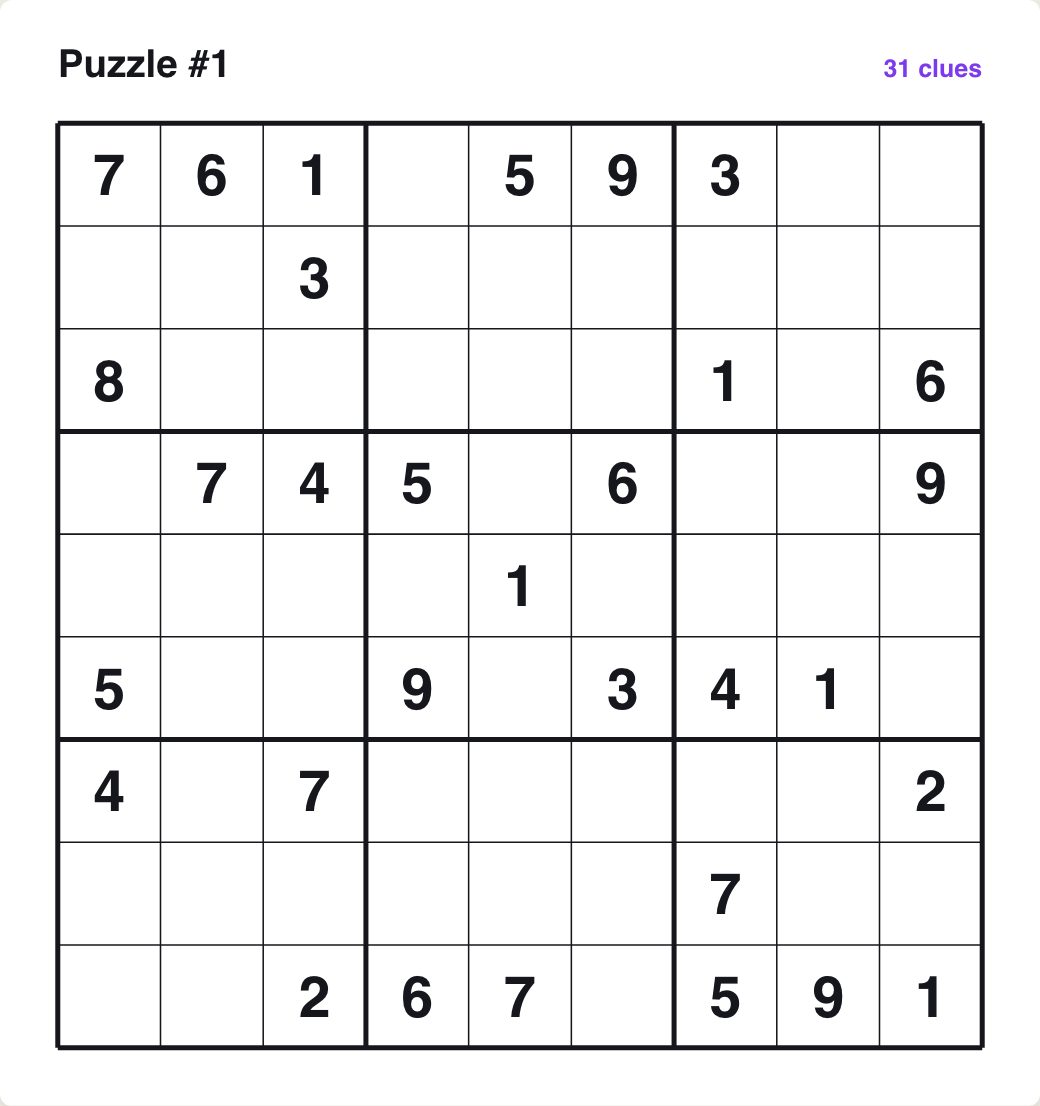
How to make printable sudoku
- Choose a difficulty. Easy, Medium or Hard. The hint under each option shows roughly how many numbers you start with.
- Pick how many puzzles. Anywhere from 1 to 24. Each one is different.
- Choose puzzles per page. One large puzzle is easiest to write in. Four or six per page makes compact practice sheets and saves paper.
- Download or print. Leave Add answer pages on to get solutions at the end.
Flip through the set with the arrows under the preview, and use the eye button to check a solution on screen. Shuffle replaces the whole set with new puzzles.
How sudoku works
A sudoku grid has 81 squares arranged in nine rows, nine columns and nine 3 × 3 boxes. The goal is to place the digits 1 to 9 so that each one appears exactly once in every row, every column and every box. Some numbers are filled in at the start. These are the givens or clues, and you work out the rest using logic alone.
A good sudoku has exactly one solution, so you never have to guess between two valid answers. Mathematicians have shown that a standard sudoku needs at least 17 givens to have a unique solution. Our hardest setting keeps around 27, which is challenging but well within reach for regular solvers.
Choosing the right difficulty
| Level | Givens | Who it suits |
|---|---|---|
| Easy | about 40 | Beginners, children learning the rules, a quick warm-up |
| Medium | about 32 | Regular solvers who want a satisfying puzzle |
| Hard | about 27 | Experienced solvers who enjoy longer chains of reasoning |
Difficulty here is measured by the number of givens, which is a simple and transparent guide. Two puzzles with the same number of clues can still feel slightly different, so if one seems tough, try the next in the set.
Solving strategies for beginners
Scan for singles. Pick a digit, say 5, and look at each box. If a box has only one square where a 5 could go (because the other squares’ rows or columns already contain a 5), write it in.
Check the crowded areas. Rows, columns or boxes with seven or eight numbers already filled in usually reveal their missing digits quickly.
Use pencil marks. In harder puzzles, write small candidate numbers in the corner of empty squares. When a square has only one candidate left, it’s solved.
Never guess. Every puzzle here can be solved by logic. If you find yourself stuck, look for a digit that can only go in one place within a single row, column or box.
Ideas for classrooms and clubs
Logic warm-ups. Start a maths lesson with an easy sudoku. It builds systematic thinking without any arithmetic at all.
Differentiated sheets. Print easy, medium and hard sets and let students choose their challenge level, then move up when they finish two in a row.
Weekly club challenge. Share the same set with everyone using the Share link. Each person can print the identical puzzles, which is perfect for comparing solving times.
Brain training. Many adults enjoy a daily paper puzzle. Print a month’s worth at four per page and keep them in a folder by your chair.
Printing tips
- Print at actual size. Choose Actual size or 100% so the grid lines stay sharp and the squares are big enough to write in.
- One per page for young solvers. The large grid has plenty of room for pencil marks.
- Answers at the back. Print only the puzzle pages for solvers and keep the answer pages for checking.
For more printable puzzles, try the maze generator or the word search maker, and see our printing guide for help with paper sizes.