Turning review into a game
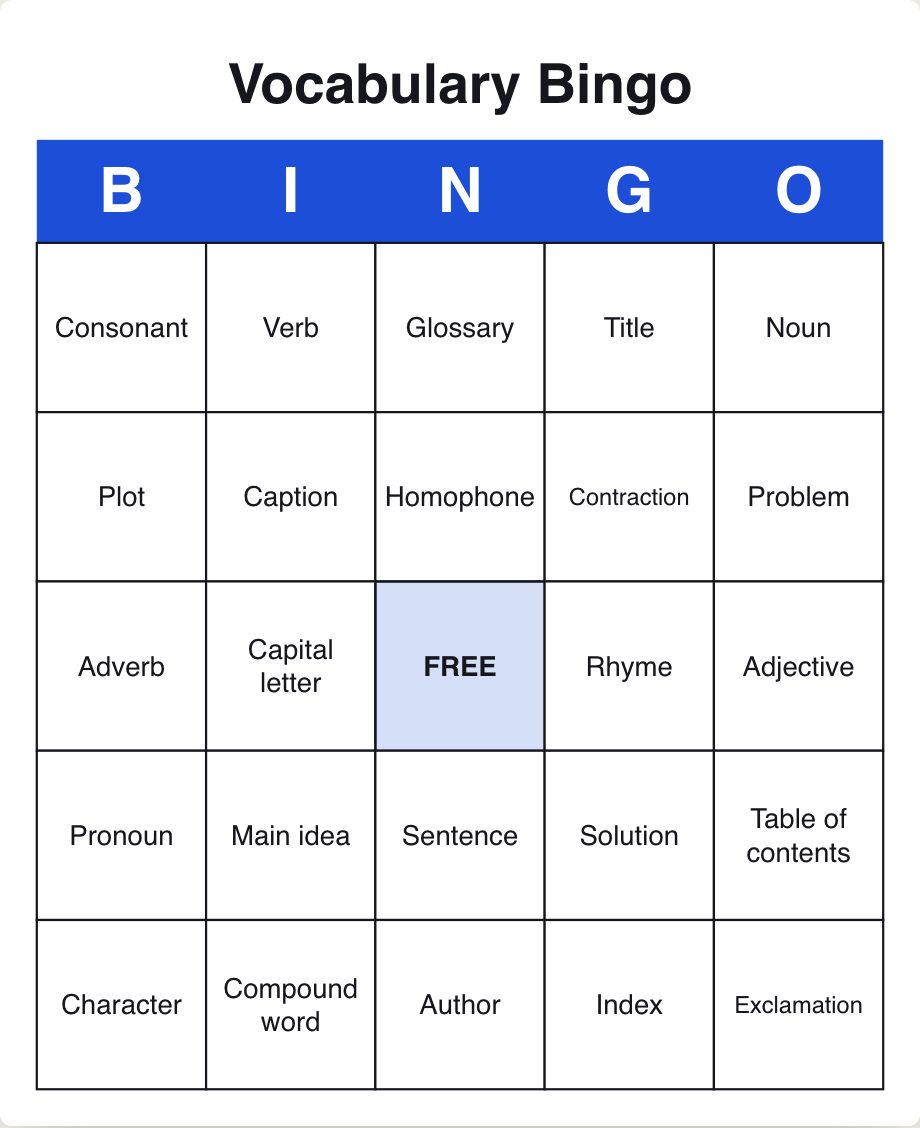
Vocabulary bingo flips the usual game around. The caller doesn’t read the word; they read the definition, an example sentence, or a picture clue. Students have to recall which term matches before they can mark it. It’s the same retrieval practice as a quiz, but students see it as a game and stay engaged until the last call.
The sample list covers common English language-arts terms for elementary grades. Replace it with your own unit: photosynthesis terms, parts of a cell, states and capitals, Spanish food words or geometry vocabulary all work the same way.
Calling ideas that deepen learning
- Definition first. Read the definition, wait five seconds, then move on. Don’t reveal the answer until the end of the round.
- Use-it-in-a-sentence. Read a sentence with the word blanked out (“The ___ of the story was a small fishing village”).
- Examples. For grammar terms, give an example (“quickly, softly, carefully”) and students mark Adverb.
- Student callers. Once the class knows the words, let a student write and read the clues.
Classroom logistics
Print one card per student plus a few spares. Two cards per page saves paper for a large class. A single large card per page suits younger students who need bigger squares. The caller sheet lists every term in random order with a tick box, so you can check a winning card quickly. Keep the caller sheet and reuse it with the same set of cards next year.
Differentiation tips
For students who need support, print a copy of the word list with definitions to keep on their desks. For a challenge, remove the free space and play for a full card. Pair the game with a word search of the same terms as homework, so students meet the spelling of each word again. More ideas are in our guide to making a word search for your class.